

★★★★★
"𝐇𝐮𝐠𝐞 𝐃𝐢𝐟𝐟𝐞𝐫𝐞𝐧𝐜𝐞"
Our senior golden used to slip every time he got excited or tried to get up in the kitchen. Since using these grips, he’s noticeably steadier and more confident.
Alexandra T.

★★★★★ Rated 4.8/5 by dog owners
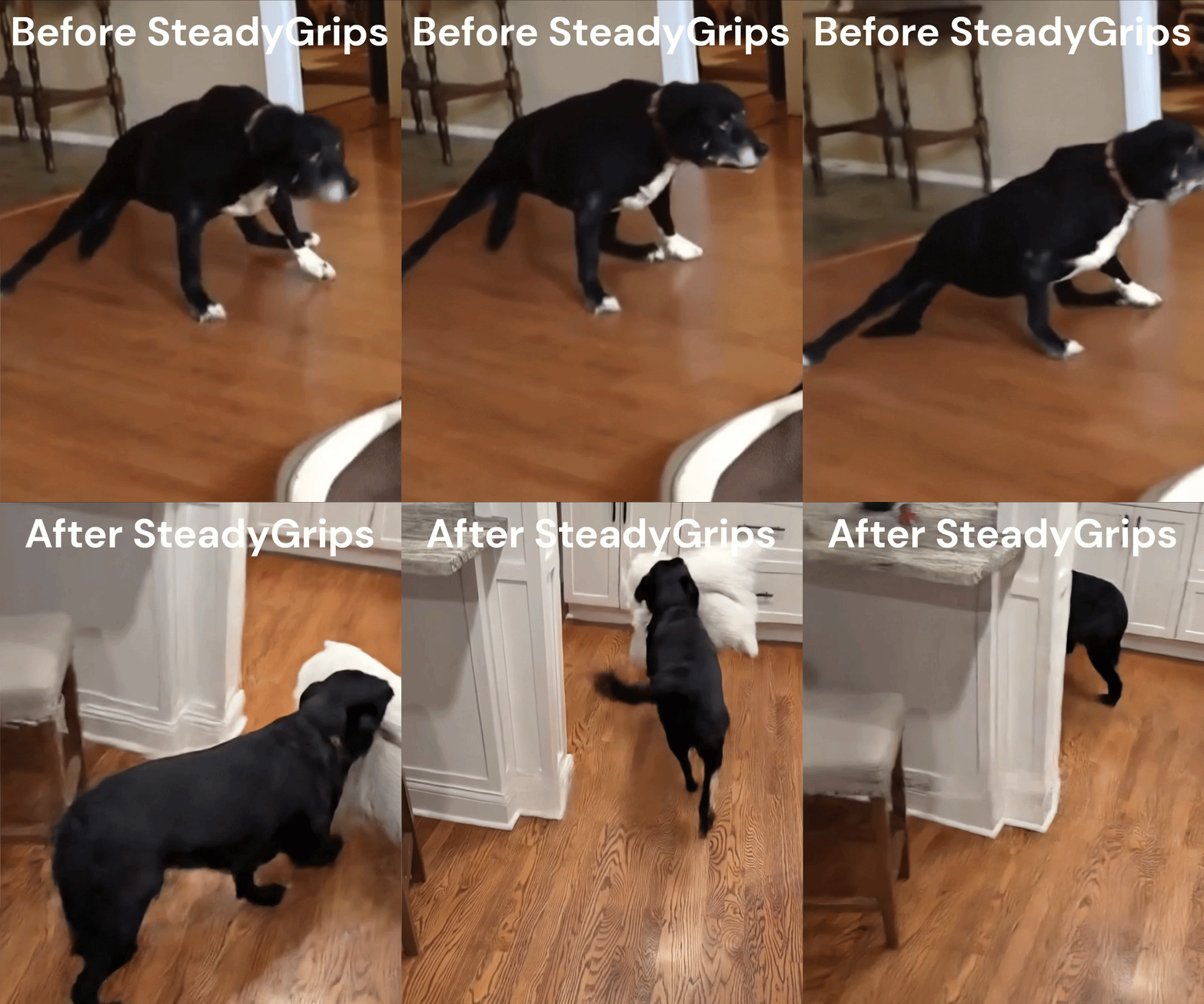

If you've watched your senior dog hesitate at the edge of a rug, scramble to get up from the kitchen floor, or refuse to cross a room they used to bound through — you know how hard it is to watch.
One owner described it perfectly: her dog was "stuck on the rug too scared to go to the hard wood floors and then skate around like a spider on roller skates."
Another said: "Poor thing slips and slides and struggles when getting up."
Another watched her dog lose confidence after a single bad slip on a slick surface — and now he won't go near that room.
Here's what most owners don't realize: that hesitation isn't your dog giving up. It's your dog bracing. They're not weak — they're afraid. They've learned that the floor can't be trusted, and every time they slip, that fear gets reinforced.
And here's the thing that changes everything: the problem may not be just age. It may not be just arthritis, or IVDD, or whatever condition your vet has identified. Those things are real, and they matter — but they're not the whole story.
Your dog is slipping because hard nails can't grip hard floors.
And that's a problem with a fixable cause — which leads directly to Reason 2.


Dogs use their nails the way soccer players use cleats.
On grass, on dirt, on carpet — the nail digs into the yielding surface and catches. That's traction. That's how a dog's body was designed to move. The paw pads provide everyday contact and friction, while the nails act as the backup system — engaging whenever the dog feels unstable, catching the ground to prevent a slip.
You never see dogs slipping on grass. You never see them scrambling on carpet. Because on those surfaces, the nail has something to catch.
But on sealed hardwood, tile, laminate, and vinyl — the nail has nothing to dig into. It just slides.
A young, strong dog compensates with muscle, pad friction, and fast reflexes. But when age, arthritis, neurological conditions, surgery recovery, or general weakness removes that reserve — the home itself becomes an obstacle course.
The problem isn't that your dog is broken. The problem is a mismatch between what dogs evolved for and what modern homes provide.
Dogs evolved for grass, dirt, and forest floors. Your home has hardwood, tile, and laminate. The nail was designed to catch in yielding terrain. Sealed flooring gives it nothing to catch.
So when your dog feels that slip and instinctively engages their nails to catch themselves — the nail just skates across the surface.
Once you understand this, one question becomes obvious: why are all the solutions targeting the paw and the floor instead of the nail?
That's Reason 3.
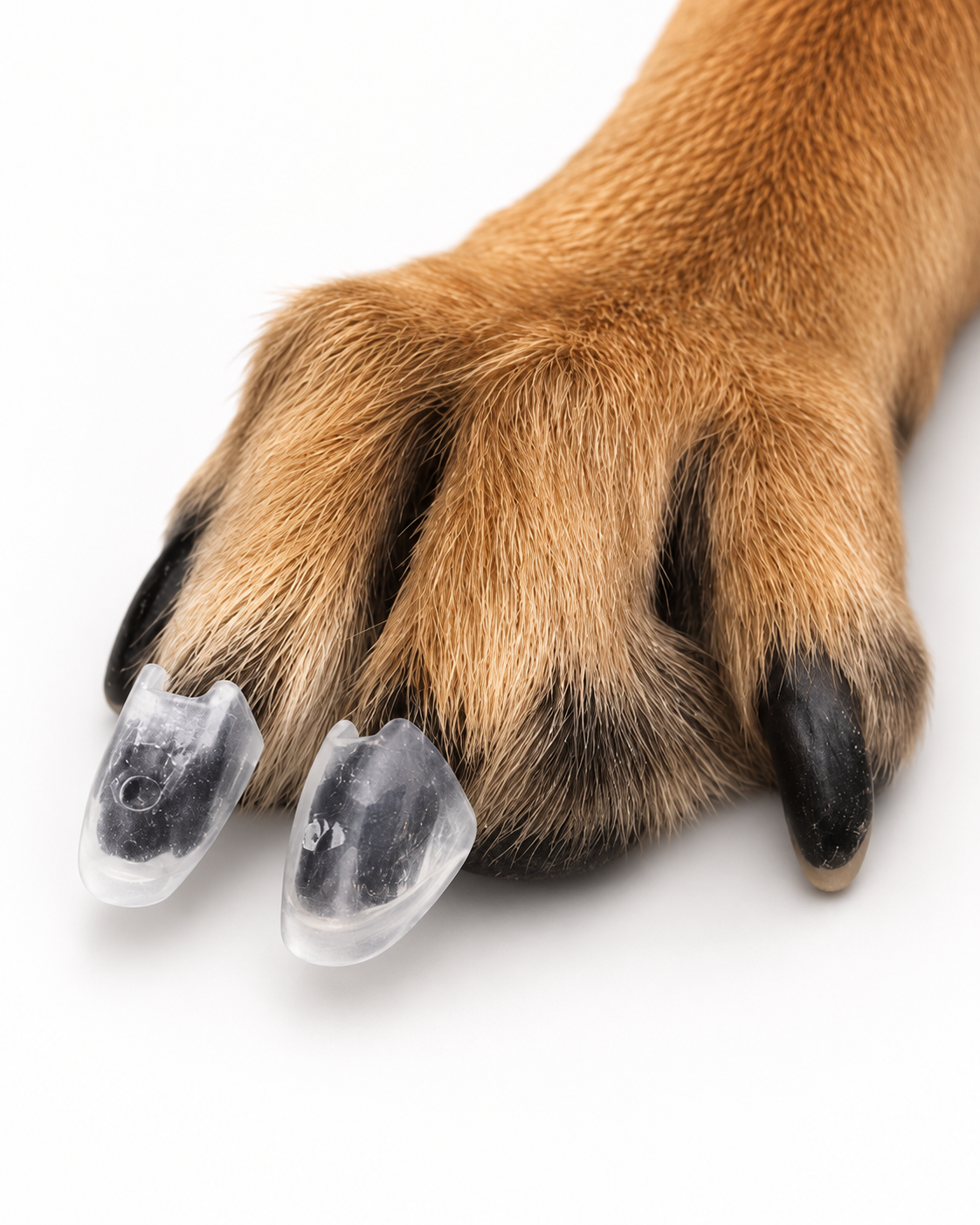

If you're reading this, you've probably already tried more than one solution. Maybe you've tried several. And you're here because none of them worked — or didn't work for long enough.
You're not wrong. You're not unlucky. Those solutions failed for a specific reason:
Every single one targets the wrong part of the dog.
Do you see the pattern?
Boots cover the paw. Socks cover the paw. Wax coats the paw. Pads stick to the paw. Rugs change the floor. Carrying replaces the dog's legs entirely.
Not one of those solutions puts grip at the nail — the exact point where the dog's natural traction system engages.
That's why they fail. Not because nothing works. Because they're all attacking the wrong part of the dog.
Which raises the question: what if you put the grip exactly where the dog's body already expects it?
That's Reason 4.
 Free Shipping
 Free Size Exchange
 Made In Canada
 Rated 4.8 Stars
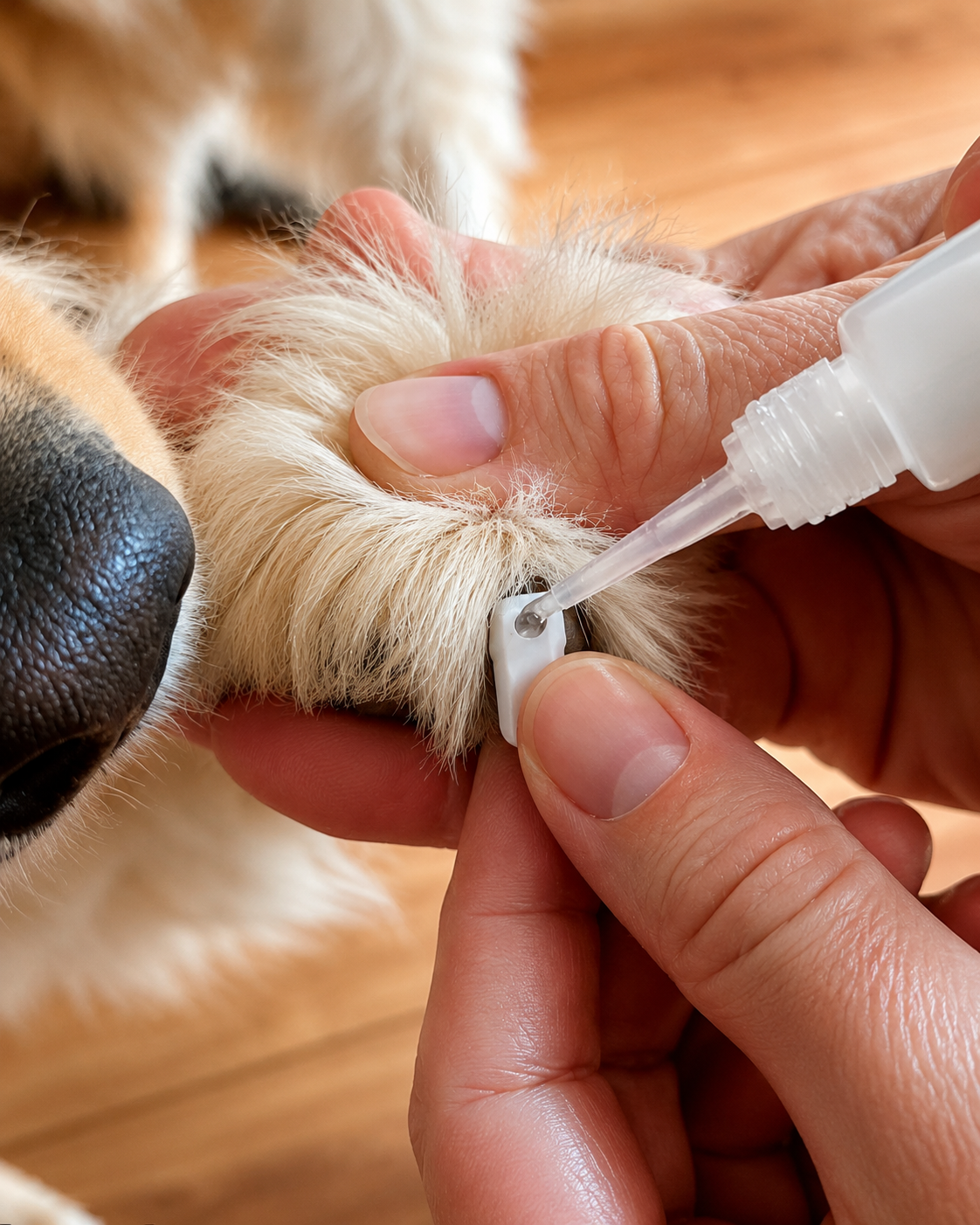

SteadyGrips work differently because they target the one point every other solution ignores: the nail tip.
Small, flexible grips that fit over the tip of each toenail. They adhere through a combination of adhesive and friction fit — designed to stay in place for 1 to 3 months. And they put a non-slip surface at the exact point where your dog's natural traction system engages.
When your dog feels unstable and instinctively engages their nails to catch themselves, the nail now has something to grip with. The floor is no longer a slide. It's a surface your dog can trust.
And unlike every other solution, SteadyGrips don't cover the paw:
One owner described the result: "the slipping and splaying are completely gone!" Another said her dog's "confidence inside the house has just blossomed" — she was stealing pens and eyeglasses again, making her owner chase her around the house.
That's what confidence looks like when it comes back.
"Won't my dog chew these off?"
This is one of the most common questions we get. The answer surprises most owners: most dogs don't realize they're wearing SteadyGrips. Because the grips sit on the non-sensitive tip of the nail — the part with no nerve endings — there's nothing for the dog to feel, bother, or react to. No boot to kick off. No sock to chew through. One owner reported that after fighting with boots and socks constantly, his dog "adjusted within a few minutes" and never noticed them again.
"Are they safe? What about the adhesive?"
SteadyGrips use a non-toxic adhesive designed to bond to the non-sensitive nail tip — not the paw pad, not the skin, not the fur. Removal is simple: grips can be filed down with a nail file and peeled off. If a grip comes off, the material is soft and non-toxic.
"How long do they last?"
SteadyGrips are designed to stay on for 1 to 3 months. Duration depends on your dog's size, gait, activity level, and nail growth. Dogs with an abnormal gait (dragging, scuffing) may wear them faster. When it's time to replace, you'll see visible wear on the grip surface — that's your signal to order a fresh set.
"Will they work for my dog's condition?"
SteadyGrips address traction — not the underlying diagnosis. If your dog has arthritis, IVDD, hip dysplasia, degenerative myelopathy, or is recovering from surgery, SteadyGrips won't treat the condition. But they may help your dog navigate your home with more confidence and less slipping while you work with your vet on the underlying issue. Many veterinarians and physical therapists recommend nail grips as part of a broader mobility plan. Show this page to your vet — we're happy to provide information for them.
Important: If your dog's slipping is new, sudden, asymmetric, painful, or rapidly worsening, please see your veterinarian before trying any mobility product. SteadyGrips are designed to support traction, not diagnose or treat medical conditions.
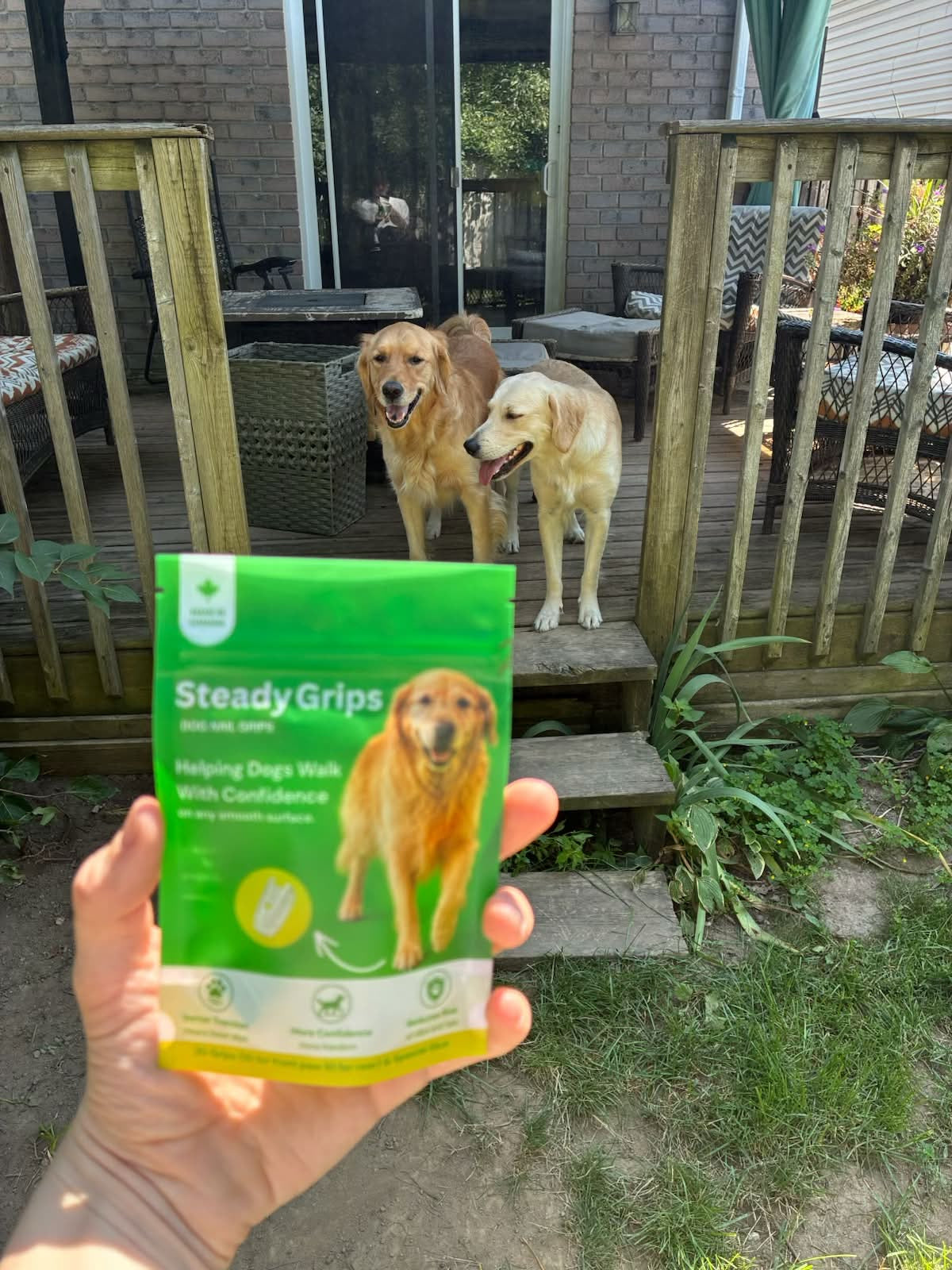

The argument makes sense on paper. But you need to know it works for a dog like yours — on floors like yours — before you'll believe it.
Here are owners who've been where you are:
Our senior golden used to slip every time he got excited or tried to get up in the kitchen. Since using these grips, he’s noticeably steadier and more confident.
Alexandra T.

My senior dog has been having the worst time sliding, falling, getting up, and a dropping morale. Within two days of taking SteadyGrips for a ride he's doing sooooo much better. Falling less, sliding less, moving faster, and getting himself up from a fall
Morgan F.

These have been a life extender for our dog, Lucki. She's doing so much better on the linoleum now. I'm grateful for this product and wish the vet had recommended them years ago!!
Taylor

I put off ordering for months and boy am I kicking myself now!!!!! Just 4 grips have changed our dogs life 1000000%! And they weren't even hard to apply! We're very happy over here!
Jamie P.
Free Shipping
Free Size Exchange
Made In Canada
Rated 4.8 Stars
We've made trying SteadyGrips as low-risk as possible. What's Included SteadyGrips nail grips — sized to your dog via the size selector below Application adhesive — non-toxic, designed for secure, long-lasting fit Application guide — step-by-step video and written instructions Free shipping — no surprise costs at checkout Free size exchange — ordered the wrong size? We'll send the right one, free That's less than one vet visit. Less than the rugs you've already bought. And over 1 to 3 months of wear, it works out to less than a dollar a day for your dog's confidence on every floor in your home. One owner put it perfectly: "50 bucks or so to give my best friend the ability to walk... it's everything." Try SteadyGrips for 30 days. If your dog isn't walking more confidently, we'll refund you — no questions asked. Price: $49.99 You don't have to return the grips. You don't have to explain why. If it doesn't work for your dog, it doesn't work — and we'd rather you spend that money on something that does. The only risk is waiting while your dog keeps slipping.


Most dogs don't realize they're wearing SteadyGrips. The grips sit on the non-sensitive tip of the nail — the part with no nerve endings. There's nothing for the dog to feel, bother, or react to. No boot to kick off, no sock to chew through.
Use the size selector above. Enter your dog's type and weight, and we'll recommend the right size. If you order the wrong size, we'll exchange it for free — no hassle.
SteadyGrips are designed to stay on for 1 to 3 months. Duration varies based on your dog's size, gait, activity level, and nail growth. Dogs with an abnormal gait (dragging, scuffing) may wear them faster. To remove them, file down with a nail file and peel off. The adhesive bonds to the nail tip, not the paw pad or skin. Dogs can't feel the grip because it's on the part of the nail with no nerve endings.
Each order includes step-by-step application instructions. Application typically takes 15-20 minutes for the first set and gets faster with practice. One person can do it — though an extra pair of hands helps with wiggly dogs.
SteadyGrips address traction, not the underlying diagnosis. If your dog has arthritis, IVDD, hip dysplasia, degenerative myelopathy, or is recovering from surgery, SteadyGrips won't treat the condition — but they may help your dog navigate your home with more confidence. Many vets and physical therapists recommend nail grips as part of a broader mobility plan. Show this to your vet.
If your dog's slipping is new, sudden, asymmetric, painful, or rapidly worsening, please see your veterinarian before trying any mobility product.
Try SteadyGrips for 30 days. If your dog isn't walking more confidently, we'll refund you — no questions asked. You don't have to return the grips.
Free Shipping
Free Size Exchange
Made In Canada
Rated 4.8 Stars
Your dog still wants to follow you. They still want to greet you at the door. They still want to be where you are — in every room, at every moment. Right now, the floor is standing in the way. It doesn't have to. SteadyGrips put the grip where your dog's body already expects it — at the nail tip. The paw stays free. The grip stays on for months. The traction travels with your dog, wherever they go. No boots to fight. No socks to twist. No wax to reapply. No rugs to take over your home. Just confident steps. On any floor. Starting today.